Explore the evolution from steam-powered factories to Industry 5.0, where automation, human collaboration, and sustainability are reshaping modern manufacturing.
Industrial systems have changed dramatically over the past two centuries. Manufacturing once depended heavily on manual labor, simple machinery, and local production. Today, automation, digital systems, artificial intelligence, and connected supply chains shape how industries operate around the world.
Industry 1.0 Changed Production Forever
The first industrial revolution began during the late 1700s with steam power and mechanized production. Factories replaced many forms of manual labor that previously depended on hand tools and small workshops.
Textile manufacturing, mining, and transportation changed rapidly during this period. Steam engines improved production speed while rail systems expanded the movement of goods across larger distances.
This shift increased industrial output significantly, though working conditions were often dangerous and environmental protections were limited or nonexistent.
Industry 2.0 Introduced Mass Production
The second industrial revolution developed during the late 1800s and early 1900s. Electricity, assembly lines, and improved transportation systems allowed manufacturers to produce goods much faster and on a larger scale.

Factories became more organized around efficiency and standardized production. Automobiles, steel production, telecommunications, and consumer products expanded rapidly during this period. Assembly line systems reduced production costs and increased access to manufactured goods for growing populations.
Industry 3.0 Brought Digital Technology
The third industrial revolution began during the second half of the twentieth century with computers, electronics, and automated machinery.
Manufacturers introduced programmable systems, robotics, and digital controls into production facilities. These technologies improved accuracy while reducing some repetitive manual labor.
Computerized inventory systems, industrial software, and early internet connectivity also changed supply chain management and communication within factories. Automation improved productivity significantly, though it also raised concerns about workforce displacement and changing job requirements.
Environmental regulations became more common during this era as governments responded to pollution, industrial waste, and growing public awareness around environmental damage.
Industry 4.0 Connected Everything
Industry 4.0 focuses heavily on connectivity, data collection, and intelligent automation. Sensors, cloud systems, artificial intelligence, and internet-connected machinery now allow factories to monitor production in real time.
Machines can communicate with one another while software systems analyze performance data continuously. Some manufacturers use predictive maintenance services to identify equipment problems before failures interrupt operations.
Digital twins, automated warehouses, and advanced robotics have also expanded throughout the manufacturing and logistics industries. These systems improve efficiency, though they also increase cybersecurity concerns, energy demand, and dependence on digital infrastructure.
Industry 5.0 Focuses More on Human Collaboration
Industry 5.0 builds on digital automation while placing greater attention on human involvement, sustainability, and resilience.
Rather than replacing workers entirely, Industry 5.0 emphasizes collaboration between people and advanced technology. Human creativity, decision-making, and problem-solving remain important alongside automation systems.
Collaborative robots, sometimes called cobots, are one example. These machines assist workers directly instead of operating separately behind barriers.
Industry 5.0 also encourages businesses to consider environmental and social impact more carefully during production planning. Energy efficiency, waste reduction, ethical sourcing, and worker well-being are becoming larger priorities across industrial sectors.
Sustainability Is Becoming Central to Industrial Planning
Earlier industrial revolutions focused heavily on speed, output, and efficiency. Industry 5.0 discussions place more attention on balancing productivity with environmental responsibility.
Manufacturers are reviewing emissions, water use, supply chain waste, and energy consumption more closely than in previous decades. Circular production systems, recycling programs, and renewable energy investments are becoming more common in industrial planning.
Climate pressure is also influencing industrial strategy. Flooding, heat waves, supply chain disruptions, and resource shortages are forcing businesses to think more carefully about long-term operational resilience. Factories designed for flexibility may respond more effectively to changing environmental and economic conditions over time.
Workforce Skills Are Changing Again
Each industrial era changed workforce demands, and Industry 5.0 is continuing that pattern. Employees increasingly need technical knowledge alongside communication, problem-solving, and analytical skills.
Workers may interact more directly with automated systems, data analysis tools, and intelligent machinery throughout daily operations. Training and education programs are becoming increasingly important as industrial systems evolve. At the same time, many businesses are recognizing that human judgment remains critical during decision-making, safety management, and innovation processes.
The Future of Industry Will Likely Blend Technology and Responsibility
Industry 5.0 is still developing, and definitions continue evolving across different sectors. Some businesses focus heavily on automation, while others place greater attention on sustainability or worker collaboration.
The broader direction suggests that future industrial systems may depend on balancing efficiency with resilience, environmental responsibility, and human expertise. Technology will likely continue advancing rapidly, though public expectations around sustainability and ethical production are also becoming stronger.
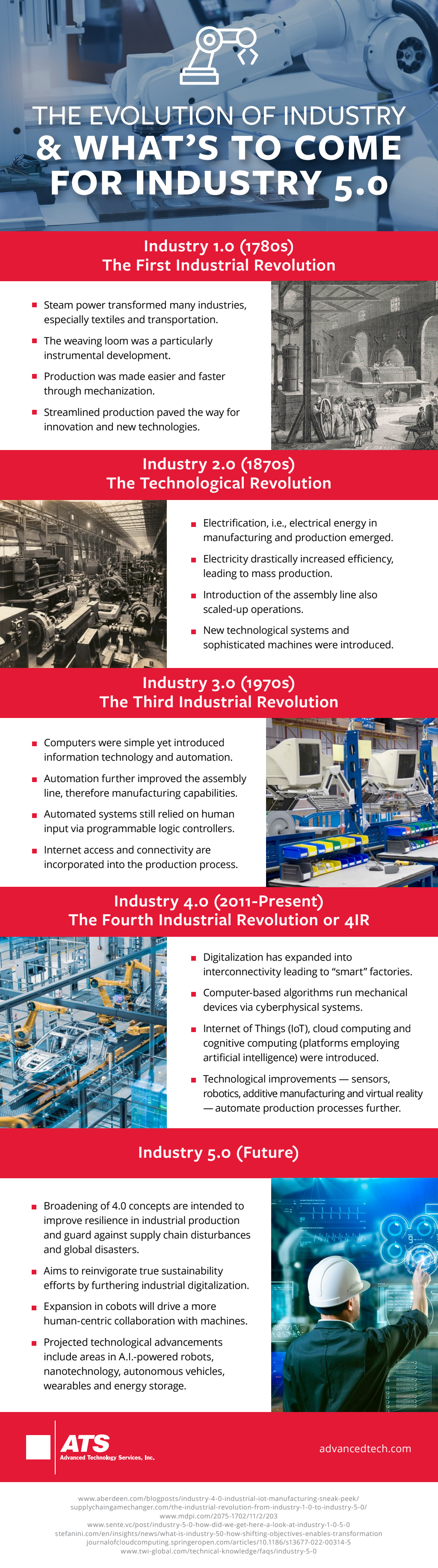
Industrial systems have evolved from steam-powered machinery to connected digital factories over several generations of technological change. As industries continue adapting to environmental pressure, workforce changes, and digital expansion, businesses are increasingly recognizing that future success may depend on balancing innovation with responsible industrial practices. To learn more, feel free to look over the accompanying resource below.
Editorial Disclaimer
This article is provided for informational and educational purposes only. Technological trends, industrial systems, and sustainability strategies may vary across sectors, regions, and organizations.
Readers should seek professional technical, engineering, or business advice before making operational or investment decisions related to industrial technologies or manufacturing systems.